

How AI Is Changing Small Businesses in 2026
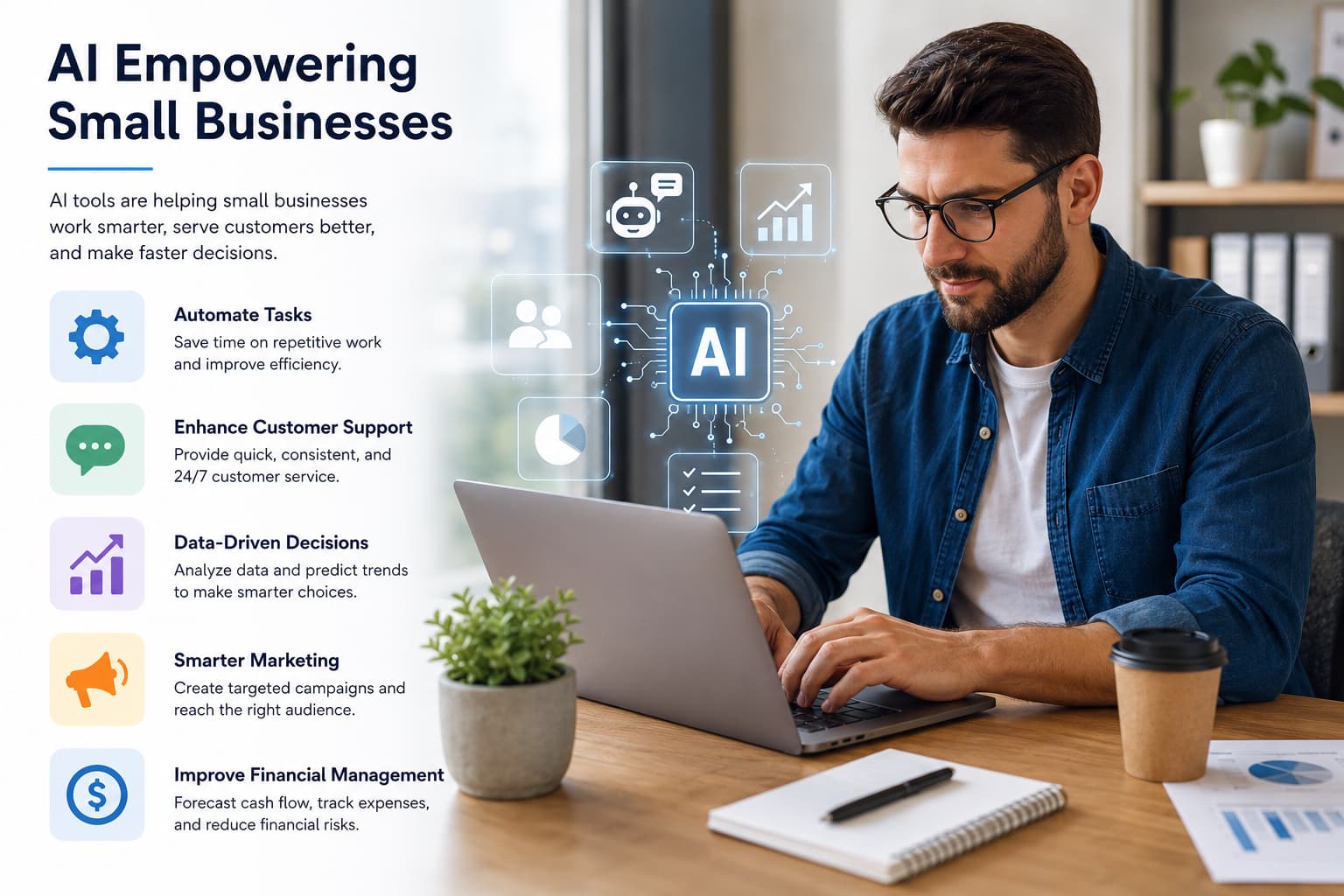
Artificial intelligence is no longer a technology reserved for large enterprises. In 2026, small businesses are using AI to automate routine work, improve customer experiences, and make faster decisions. From local retailers and service providers to online stores and consultants, AI tools have become more accessible and affordable.
Recent surveys show that AI adoption among small businesses continues to grow. The U.S. Chamber of Commerce reported that nearly 60% of small businesses used generative AI in 2025, up significantly from previous years, while other industry studies indicate adoption continues to accelerate in 2026. Businesses that successfully implement AI are typically using it for specific tasks rather than attempting company-wide transformations.
For small business owners, the question has shifted from “Should we use AI?” to “Where can AI deliver the most value?” This article explores how AI is changing small businesses in 2026 and what owners should consider when adopting these tools.
Table of Contents
- The Growing Role of AI in Small Business
- How AI Is Transforming Daily Operations
- AI Use Cases Across Business Functions
- Challenges of AI Adoption
- Practical Tips for Getting Started
- Frequently Asked Questions
- Conclusion
The Growing Role of AI in Small Business
AI has become part of everyday business operations. Unlike earlier technologies that required significant investment, many AI tools are now available through subscriptions or built directly into existing software.
Key Statistics
- Nearly 60% of small businesses reported using generative AI in 2025.
- A QuickBooks survey found that 68% of respondents used AI regularly, with 74% saying it improved productivity.
- The U.S. Chamber of Commerce found that 84% of small businesses planned to increase their use of technology platforms.
- JPMorganChase Institute research notes that AI adoption is increasing fastest among newer businesses.
These figures suggest that AI is becoming a competitive advantage, particularly for businesses with limited staff and resources.
How AI Is Transforming Daily Operations
Automating Repetitive Tasks
Many small businesses spend considerable time on administrative work. AI can assist with:
- Appointment scheduling
- Email drafting
- Invoice processing
- Meeting summaries
- Data entry
- Inventory updates
By reducing time spent on routine tasks, employees can focus on customer service and business development.
Improving Customer Support
AI-powered chatbots and virtual assistants are now handling common customer questions around the clock.
Example:
A local plumbing company can use a chatbot to:
- Answer service-related questions
- Collect customer details
- Schedule appointments
- Provide estimated response times
This allows businesses to respond faster without hiring additional staff.
Supporting Better Decision-Making
AI tools can analyze large amounts of information quickly and identify trends that may otherwise go unnoticed.
Business owners can use AI to:
- Forecast sales trends
- Analyze customer behavior
- Monitor marketing performance
- Identify seasonal demand patterns
Rather than replacing human judgment, AI acts as a decision-support tool.
AI Use Cases Across Business Functions
Marketing and Content Creation
Marketing remains one of the most common uses of AI among small businesses.
AI tools can help with:
- Blog outlines
- Social media captions
- Email campaigns
- Keyword research
- Advertising copy
For example, a small e-commerce store can generate multiple ad variations and test which messages perform best.
Sales and Lead Management
AI is changing how businesses find and manage customers.
Common Applications
- Lead scoring
- Sales forecasting
- CRM automation
- Personalized recommendations
- Follow-up reminders
Businesses can prioritize high-value prospects instead of manually reviewing every inquiry.
Financial Management
Accounting software increasingly includes AI features.
Examples include:
- Expense categorization
- Cash flow predictions
- Fraud detection alerts
- Automated bookkeeping assistance
These capabilities can help owners maintain better financial visibility throughout the year.
Human Resources
Small businesses with limited HR resources are using AI to streamline hiring.
AI can assist with:
- Screening resumes
- Drafting job descriptions
- Scheduling interviews
- Employee onboarding materials
However, hiring decisions should continue to include human oversight to minimize bias and ensure fairness.
Challenges of AI Adoption
While the benefits are substantial, AI adoption is not without challenges.
Data Privacy and Security
Businesses must understand how their data is stored and processed. Sensitive customer information should not be shared with tools that lack appropriate safeguards.
Employee Training
Many employees require guidance on how to use AI effectively.
Experts generally recommend:
- Starting with one or two tools.
- Providing basic training.
- Measuring results.
- Expanding gradually.
Cost Considerations
Although many AI tools are affordable, costs can increase when businesses subscribe to multiple services. Owners should evaluate return on investment before expanding their AI stack.
Regulatory Developments
AI regulations continue to evolve globally. Businesses should monitor changes related to privacy, transparency, and compliance requirements in their markets.
Expert Insights
Industry research consistently points to a common pattern: businesses achieve the best results when AI is applied to specific problems.
Examples include:
- Reducing customer response times.
- Automating invoicing.
- Improving inventory forecasting.
- Enhancing marketing efficiency.
Organizations that treat AI as a practical business tool tend to see better outcomes than those adopting it solely because of market trends.
Actionable Tips for Small Business Owners
Businesses considering AI adoption in 2026 can start with these practical steps:
1. Identify Time-Consuming Tasks
Track repetitive activities over a week and determine which could be automated.
2. Start Small
Choose one area such as customer support or marketing before expanding.
3. Measure Performance
Monitor metrics such as:
- Time saved
- Customer satisfaction
- Revenue growth
- Operational efficiency
4. Train Employees
Ensure staff understand both the benefits and limitations of AI tools.
5. Maintain Human Oversight
AI should support employees rather than replace accountability and decision-making.
Frequently Asked Questions
1. How are small businesses using AI in 2026?
Small businesses are using AI for marketing, customer support, scheduling, accounting, and data analysis. Many organizations adopt AI to automate repetitive tasks and improve productivity. The most successful implementations focus on solving specific operational challenges rather than attempting broad transformation initiatives.
2. Is AI expensive for small businesses?
Not necessarily. Many AI tools offer free plans or affordable monthly subscriptions. Costs vary depending on features and usage levels. Small businesses often begin with one or two tools and expand only after demonstrating measurable benefits such as time savings or improved customer engagement.
3. Can AI replace employees?
AI is more likely to augment employees than replace them. It handles repetitive and administrative tasks, allowing staff to focus on strategic work, customer relationships, and problem-solving. Human oversight remains essential for decisions involving ethics, customer service, and business strategy.
4. Which industries benefit most from AI?
Retail, professional services, healthcare, hospitality, and e-commerce are among the industries seeing significant benefits. However, nearly every small business can identify at least one process that may be improved through automation, analytics, or AI-assisted communication tools.
5. What are the risks of using AI?
Potential risks include data privacy concerns, inaccurate outputs, overreliance on automation, and regulatory compliance issues. Businesses should review vendor policies carefully and ensure employees understand when human review is necessary before using AI-generated information in operations.
6. How can a small business start using AI?
Businesses should begin by identifying a repetitive task that consumes significant time. Examples include responding to customer inquiries or creating marketing content. Starting with a single use case makes implementation simpler and allows owners to evaluate results before investing further.
7. Will AI continue to grow beyond 2026?
Current trends suggest continued growth in AI adoption across businesses of all sizes. As tools become more accessible and integrated into existing software, AI is expected to become a standard part of daily operations rather than a separate technology investment.
Conclusion
AI is changing small businesses in 2026 by making advanced capabilities more accessible than ever before. Whether improving customer support, automating administrative work, or helping owners make better decisions, AI is becoming an important part of modern business operations.
The businesses benefiting most are not necessarily spending the most money. Instead, they are adopting AI strategically, measuring outcomes, and expanding gradually. For small business owners, thoughtful implementation remains the key to long-term success.




No Comment